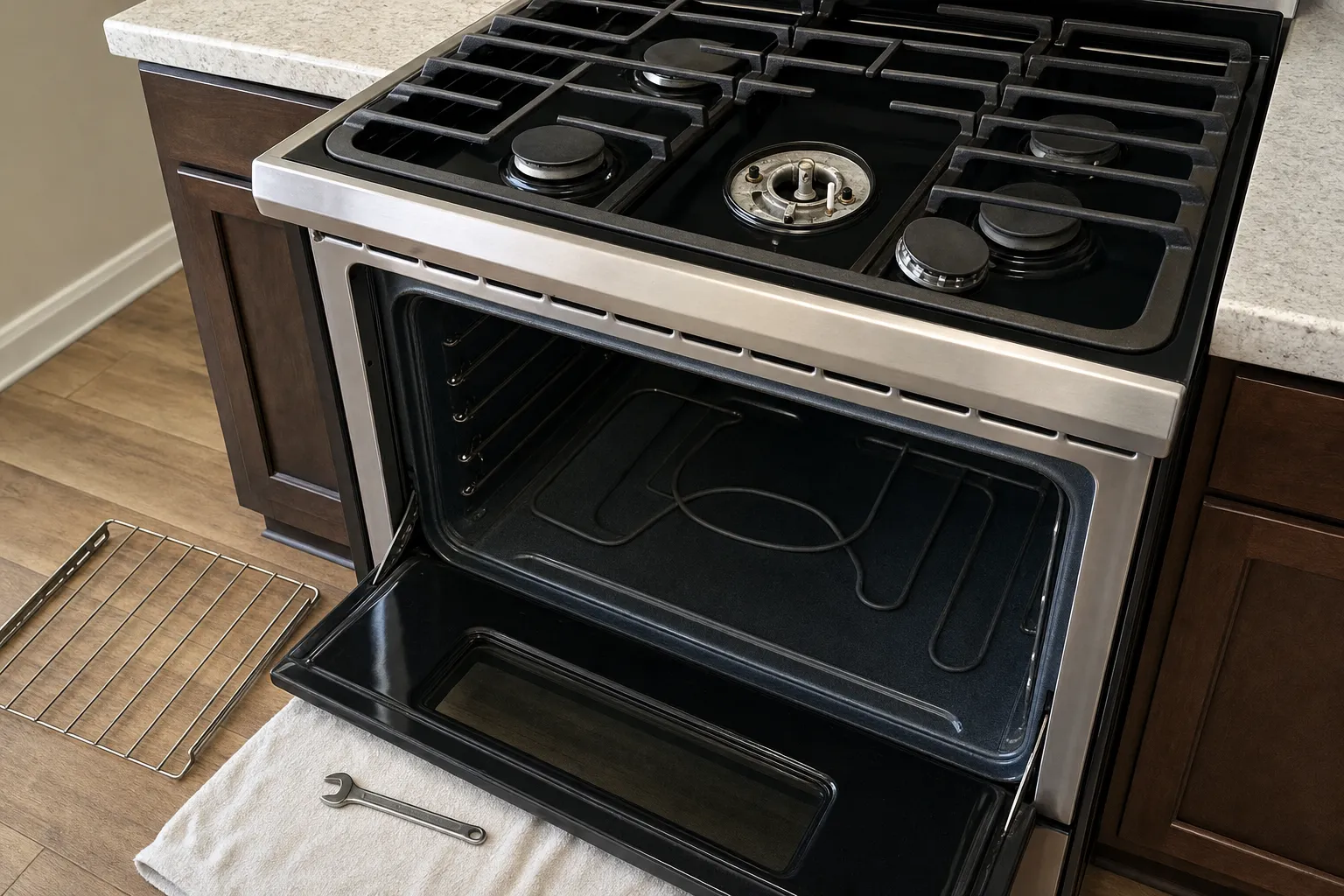
Field Notes · How-to
How to Check a Wolf Oven With a Thermometer
An oven thermometer, one rack and about forty-five minutes show whether a Wolf oven really runs cold. Where to put it, when to read it, how to average the swings, and which result is worth a call.
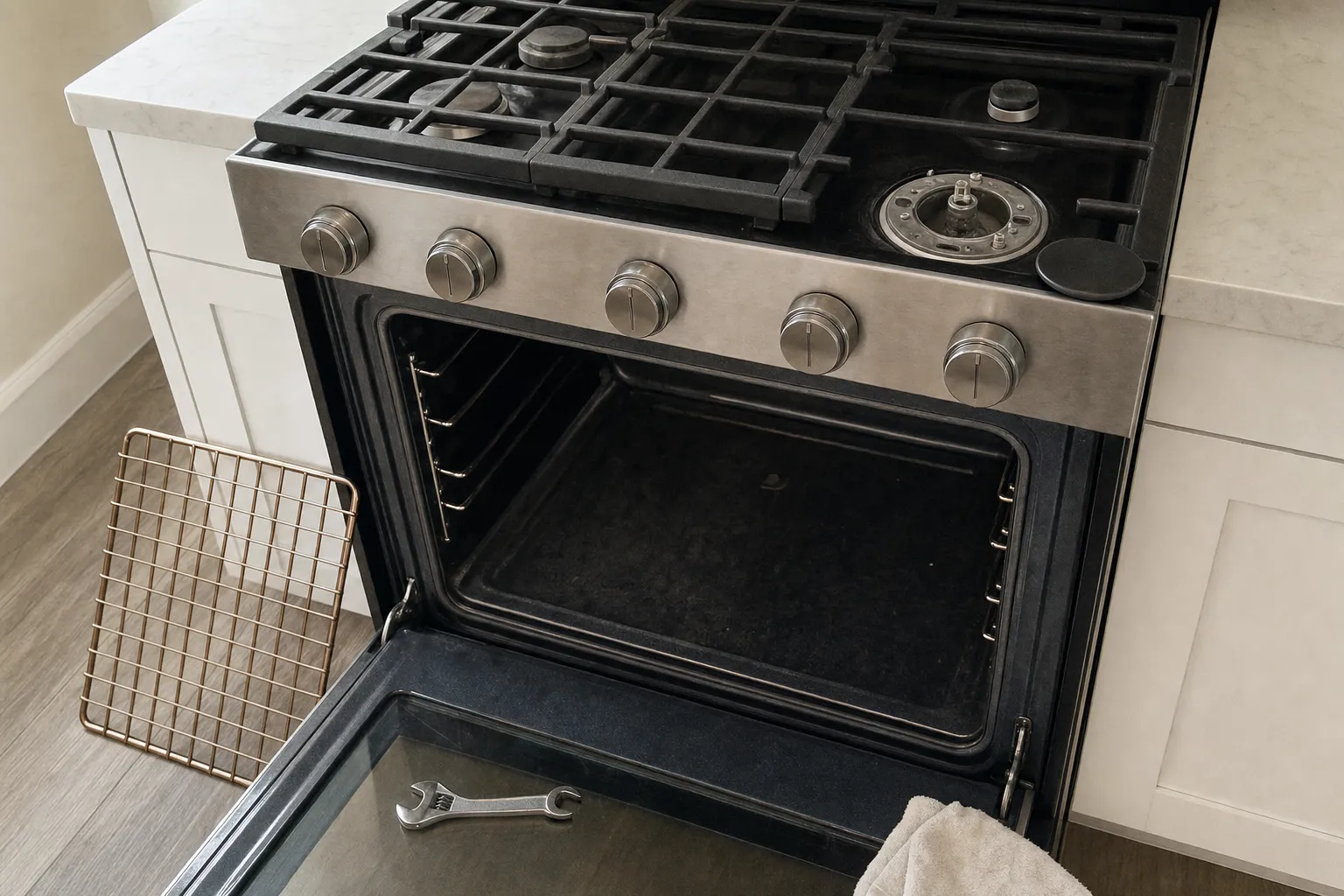
An oven that bakes slowly or unevenly gets blamed on its sensor more often than it deserves. Before anyone meters a part, a plain oven thermometer and the better part of an hour will tell you whether the cavity actually runs cold, and the numbers you write down make a visit shorter if you do need one.
What you are measuring
An oven does not sit still at its set point. It heats until its sensor reports the target, switches the heat off, lets the air drift down, then switches it back on, so the air temperature rises and falls around the number you chose. A single thermometer reading catches one moment of that cycle. That is why the steps below average four readings instead of trusting one.
It is also a measurement and nothing more. Wolf’s own guidance is that adjusting an oven’s calibration is possible but rarely needed, that it belongs to a service technician, and that an offset changes every cooking mode, not only Bake.
The check, step by step
You need Oven-safe thermometer Time about 45 minutes
-
Step 1
Leave one rack, in the middle
Take out every rack but one and set that one in the centre position. Stand an oven-safe thermometer in the middle of the rack, turned so you can read it through the door glass.
-
Step 2
Plain Bake at 350°F
Choose Bake, not a convection mode, and set 350°F. Wait until the oven tells you preheat is done — on a current Wolf dual fuel range that is a chime.
-
Step 3
Four readings, five minutes apart
Ten minutes after preheat ends, read the thermometer, then again every five minutes until you have four readings. Read through the glass where you can; every door opening lets heat out.
-
Step 4
Average them and write it down
Add the four readings and divide by four. Note that average, how long preheat took, and the model and serial from the tag — on a range, at the bottom right of the control panel with the door open.
-
Step 5
Compare, then stop
An average near 350°F means the oven is holding its set point and the trouble lies elsewhere. A clear gap that shows up again on a second day is worth a call. Do not try to correct it from the control panel.
Reading the result
An average close to the set point. The oven is holding temperature. Uneven browning then points at rack height, pan colour or air movement; in a convection oven, a fan that has stopped turning leaves hot and cold corners even when the average is right.
An average clearly low or high, on two different days. Something in the heating loop has drifted — the sensor, the element or burner, or a door seal letting heat out. What sensor and calibration work costs is on the oven sensor and calibration cost page.
Preheat taking far longer than it used to. That is a question of heating power rather than of the reading, and the field note on an oven that will not reach temperature covers what to look at next.
Before you start, in a Seattle winter
A storm outage can leave a dual fuel oven with its clock blank and its control lock set; clear both before you measure, or the oven may not start a bake at all. On an all-gas range, an oven left on through a brief cut should relight when the power returns — if it does not, turn the knob off and back on, and never try to light a gas oven by hand. If you ever smell gas, stop, leave the house, and call Puget Sound Energy or 911 from outside.
Still asked on the phone
Should I trust the temperature my Wolf oven shows?
Treat it as the target rather than a measurement of the air. Every oven's air swings around its set point as the heat switches on and off, so one glance at a thermometer, or at the display, is only a snapshot. An averaged reading is the fair test, and if it stays well off, Wolf Repair Seattle, (206) 339-4211, meters the sensor itself.
Can I recalibrate a Wolf oven myself?
Wolf's own guidance is that calibration is rarely needed and belongs to a service technician, and that an offset shifts every cooking mode at once. So measure, write the readings down and stop there. Wolf Repair Seattle, (206) 339-4211, checks the sensor and the heat source before any offset, because an offset laid over a failing part only hides it.
- Signed
- Greg Lindqvist
- Role
- Cooking-appliance technician — gas ignition and burners
- In the trade
- 18 years in the trade