Field Notes · Wolf Range Repair
Wolf Burner Clicks But Will Not Light: Reading the Spark
A Wolf burner that clicks without lighting has already told you the spark circuit is alive. Here is what that narrows it down to, what to check in five minutes, and when the fault is genuinely ours.
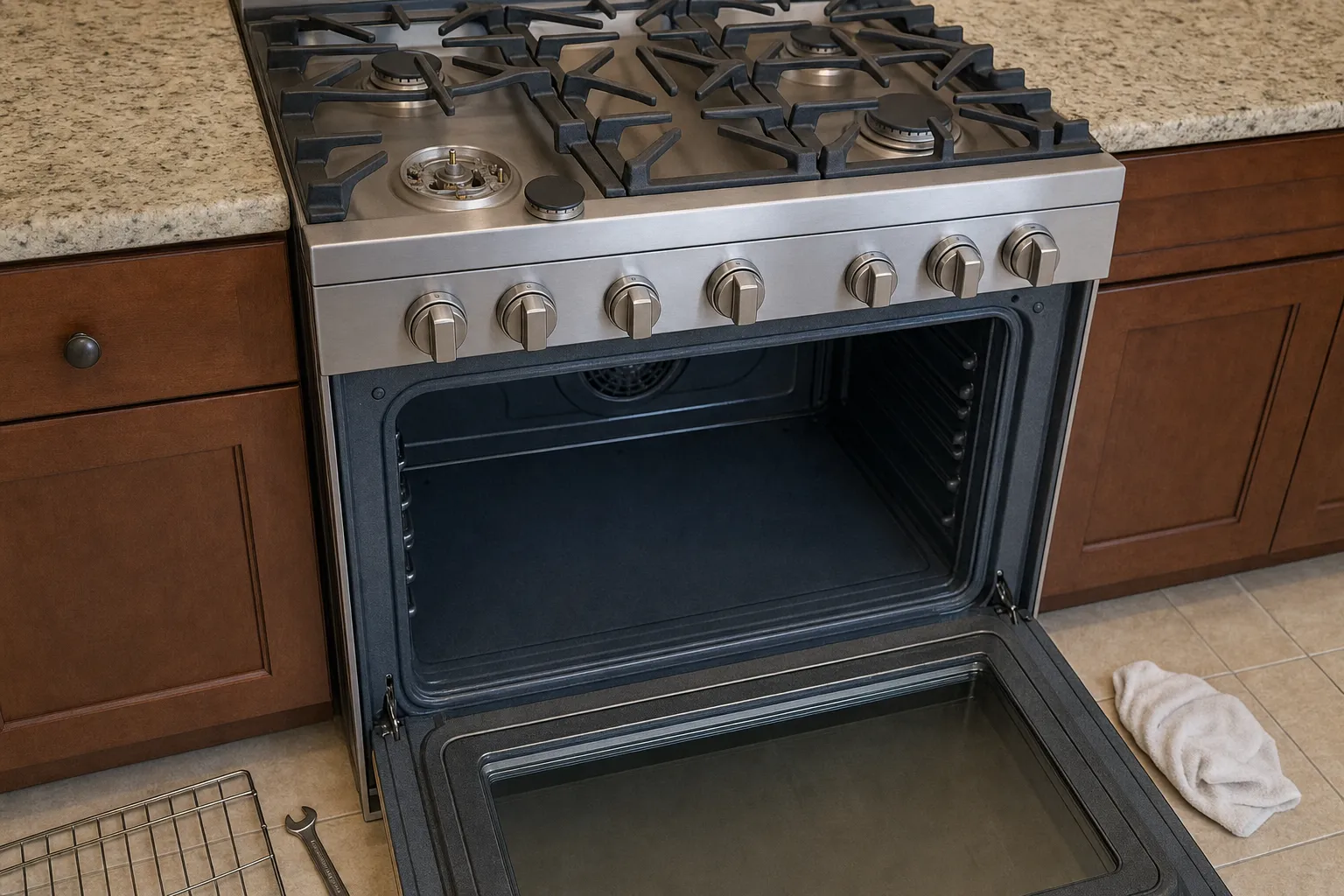
A Wolf burner that clicks and clicks without producing a flame is one of the most common calls we take across Seattle, and it is also one of the few where the appliance has already handed you half the diagnosis. Clicking is not a symptom of a broken igniter. Clicking is the igniter working.
What the clicking actually proves
To make that noise, four things have to be true. The range has power. The spark module is generating high voltage. The switch under that particular knob has closed and told the module to fire. And the electrode at the burner is intact enough to jump a spark to ground.
That is most of the ignition system confirmed as healthy in the first two seconds. What clicking says nothing about is whether gas arrived at the burner and whether it arrived in the right place. So the fault sits in a much smaller box than most people assume: gas delivery, burner assembly, or the geometry between the two.
The three things that stop a lit flame
The cap is not seated. Wolf sealed burners use a cap that sits into a machined recess. A millimetre out of position and the gas leaves the ports on the wrong side of the spark gap. Lift it off, set it back down and let it find its own seat — it should feel like it drops rather than balances. This is the single most common cause and it costs nothing to rule out.
The ports are blocked. After a boil-over, sugar and starch bake into the ring of ports and close the ones nearest the electrode. The burner may still light weakly on the far side, or not at all. A soft brush and a paperclip straightened out will clear them. Never drill them out; the port size sets the flame quality.
Everything is still wet. A cleaned cooktop that gets used within the hour is a classic no-light. A damp ceramic insulator offers the charge a shortcut: instead of jumping the air gap it was meant to cross, it runs down the film of water straight to earth. The burner sparks loudly, looks completely normal, and lights nothing. Give it a couple of hours dry or a careful pass with a hairdryer on low.
When one burner fails and when all of them do
The pattern matters more than the symptom. One burner misbehaving while the rest are normal is a burner-level fault: cap, ports, electrode, or the orifice behind it. That is a small job.
All of them clicking without lighting is a different animal. That is gas supply, a closed manual valve after work elsewhere in the house, a tripped excess-flow device, or a regulator problem. It also happens the day a gas fitter has been in the building. If nothing on the cooktop will light and the oven will not either, stop poking at burner caps and check whether the house has gas at all — and before anyone works on it, know how to shut off the gas and the power to the range.
Somewhere in between: two burners failing together, while the rest light, points away from either burner and towards what they share — the spark module or the wiring between it and them.
Seattle gas supply and cold-weather quirks
We get a small run of these calls every winter. Regulators sit outside, and a cold snap combined with high demand across a block can pull delivered pressure below where a large dual-fuel range wants it. The symptom is not a dead burner — it is a burner that lights late, burns lazily, or drops out under the extractor fan at full speed.
That last detail is worth knowing. A powerful hood in a tight, well-sealed kitchen can pull enough air out of the room to disturb a burner flame, particularly on the front burners closest to the intake. If your no-light only happens with the hood on high, you have found a ventilation problem masquerading as an ignition fault, and make-up air is the real fix.
Where the line is between DIY and a service call
Cap seating, port clearing and drying out are all yours. They are mechanical, reversible, and require nothing sharper than a brush.
Everything past that involves either a meter or a manometer. Testing whether the spark module output is weak, checking that the flame is sensed once lit, measuring gas pressure at the range, replacing an electrode without cracking its ceramic — all of these have proper procedures and specific numbers to hit, and guessing at them is how a small repair turns into a replaced control board that changed nothing. What electrode and module work costs is printed on the igniter and spark module cost page.
Call sooner rather than later if you can smell gas with the knobs off, if every burner has changed behaviour at once, or if the burner lights and then goes out on its own within a few seconds. That last one is flame sense, and it is a fault that will only get more frequent from here.
Still asked on the phone
Why does my Wolf keep clicking after the burner lights?
Continuous sparking after ignition means the flame sense circuit is not confirming a flame. It is usually a wet or carbon-fouled electrode, or a burner cap sitting slightly off its seat so the flame never reaches the sensing point. It is not dangerous, but it will keep clicking until it is corrected.
Is it safe to keep using the other burners?
If one burner will not light and the rest behave normally, yes. Stop and ventilate if you smell gas with everything switched off, or if more than one burner has changed behaviour at the same time — that pattern points upstream at supply or the spark module.
Can a boil-over kill a burner permanently?
Rarely. Liquid getting into the burner ports and down onto the electrode causes exactly this fault, and it usually recovers once everything is fully dry. What does cause lasting damage is scrubbing the ceramic electrode with anything abrasive.
- Signed
- Greg Lindqvist
- Role
- Cooking-appliance technician — gas ignition and burners
- In the trade
- 18 years in the trade